View:55940Time:2026.10.14
Every year, a handful of design directions dominate race medals — and every year, race directors ask us the same thing in January: what are runners actually excited about, and what does it cost to build? This list answers both. These are the ten custom marathon medal design ideas generating the most interest from our clients in 2026, each with the honest per-medal cost impact, the type of event it suits, and the design details that make or break it.
We produce medals for major marathon programs alongside club races and school events, so everything below is grounded in what's actually manufacturable and what actually survives a finish line. Nothing here is a concept render that can't be cast.
The biggest medal design trends in 2026 are interactive and dimensional features — spinner centers, cut-out negative space and 3D sculpted relief — combined with strong color contrast, whether through dual-tone plating or glow-in-the-dark enamel. Custom die-cut shapes are also surging because they turn a medal into a piece of event branding rather than a generic disc. The common thread: runners now see the medal as social media content, so designs are being built for photographs rather than for close inspection.
A spinner medal has a rotating element built into the face — a disc, a ring, a gear, sometimes a small figurine — that spins freely while the medal hangs.
Why it works: It's the single most photographed medal feature in circulation. Given one medal and five seconds, a runner will spin it, film it, and post it. That behavior is worth more to a race than any static design, because it produces motion content in a category full of still photos.
Cost impact: +$0.80 to $2.00 per medal, depending on the mechanism and the number of moving pieces. It also requires zinc alloy and adds mold complexity.
Best for: Fundraising races that need visibility, anniversary events, and any race competing for social media attention. Less suitable for very high volumes where per-unit cost dominates.
Design tip: Keep the spinning element visually distinct — the design needs to read clearly in a still frame, because half the people who see the post will never play the video. Also ask your factory about the rivet failure mode. A spinner that loosens after a season of handling is worse than no spinner at all, and reputable factories will talk about testing.
Instead of a disc, the medal is die-cut into a shape with meaning: the outline of the host city or state, a running shoe, a mountain profile the course crests, or even the route itself.
Why it works: It announces the event's geography at a glance and looks deliberate rather than generic. For destination races, the shape becomes the brand — runners recognize that silhouette in a photo instantly.
Cost impact: +$50 to $150 on tooling plus a modest per-unit increase (often +5–15%), because cutting and polishing a custom outline uses more labor and creates more edge waste. Irregular shapes also need careful artwork margins.
Best for: Destination marathons, trail races built around a defining terrain, and events building a long-term visual identity.
Design tip: Silhouettes with narrow points or thin appendages — a mountain with a needle peak, a bird in flight — tend to bend or chip at the tips. Thicken the extremes before production. If the shape is very irregular, discuss the hanging hole placement early: the medal should hang balanced, not tilted.
A cut-out medal has holes or voids punched through the metal — the gaps of a bridge, the streets between city blocks, negative space forming a runner's silhouette, or the letters of the event name punched clean through.
Why it works: Negative space creates high contrast without increasing cost the way extra enamel does — the sky or your shirt color becomes part of the design. Photographically, it's striking: the medal reads as lighter, more modern and more sculptural.
Cost impact: +$0.30 to $0.80 per medal, mostly for the additional tooling detail and edge finishing. Deeper cut-outs and multi-layer voids push toward the higher end.
Best for: Modern, design-forward events and rebrands. Works especially well when the event name or year is the cut-out element.
Design tip: Keep structural integrity in mind. Too many voids makes a thin medal feel flimsy and gives polishing more opportunities to distort edges. Ask for a rendering that shows actual metal coverage, not just the artwork.
Glow-in-the-dark medallions use luminous enamel in specific color areas so the design lights up in the dark — often the event name, a moon, or a route line.
Why it works: It's a functional novelty tied to the event format. For night runs and evening finish-line parties, the medal becomes part of the experience instead of a souvenir of it. Kids' events love them too, which is why we see them across both night races and school sports days.
Cost impact: +$0.15 to $0.35 per medal. Cheaper than most people assume, and it's one of the most distinctive upgrades available at that price.
Best for: Night races, holiday-themed runs, kids' races, and events with an evening ceremony.
Design tip: Design the glow area as a deliberate element — a defined shape, lettering, or icon. Glow spread across a large uneven area looks patchy. And keep in mind that the glow color is a material choice, not a printed color; greener and blue-greener tones are brightest.
Two plating finishes on one medal — shiny gold recessed with black nickel, antique silver with gold highlights, or rose-gold accents on a dark base.
Why it works: It looks like jewelry. Dual-tone plating adds read depth without adding enamel, which means a design can feel rich and detailed at a lower color count. It also photographs with strong contrast, which helps at a distance.
Cost impact: +10–20%, because the medal passes through plating twice with masking in between. It also adds a day or two to production.
Best for: Flagship and anniversary races, elite award medals, and any event where the medal doubles as a premium keepsake.
Design tip: Dual-tone only works with a clean, well-separated design. If the relief is busy or the two areas interlock tightly, the mask line looks messy and the result looks accidental rather than intentional. Simplify the relief before you approve dual-tone.
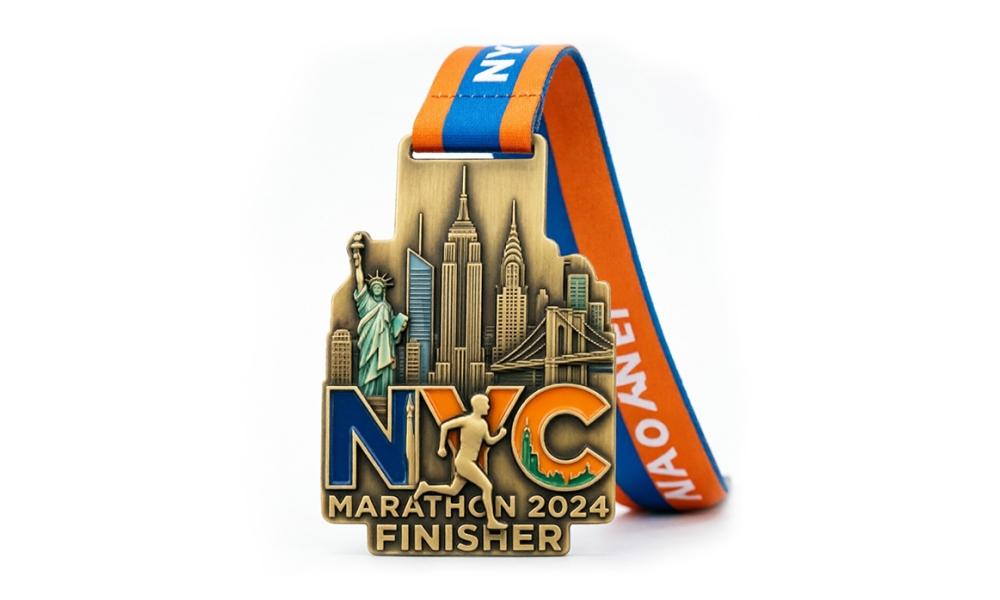
Deep relief sculpture — a city bridge in three dimensions, a mountain emerging from the medal face, a mascot figure, or a sculpted runner. This is the classic premium marathon approach.
Why it works: Dimensional relief catches light and shadow, which means the medal looks different from every angle and reads as substantial in hand. It's the direction most large marathons have moved toward because it makes the medal feel like an object rather than a token.
Cost impact: +$0.60 to $1.50 per medal plus higher tooling ($150–$300). Requires zinc alloy; deep relief also needs more material thickness behind the high points.
Best for: Full marathons and half marathons — events where established runners have other medals to compare against.
Design tip: Sculpting has a scale limit. A landmark with filigree detail won't read at 76mm. Designers should think in masses, not lines: three or four clear volumetric shapes will look better than a faithful miniature of a complicated structure. Ask your factory's design team for a sculpture review before tooling — it's the difference between striking and unreadable.
Hard enamel (also called cloisonné) fills color flush with the metal and then polishes the whole face smooth, so the medal has no recessed texture — it feels like polished stone.
Why it works: It's the most tactile finish in medal manufacturing, and it signals premium instantly. It also resists the enamel bleeding and uneven fill that can affect soft enamel on intricate designs, which makes it a good match for detailed artwork.
Cost impact: +15–25%, from multiple filling and polishing passes. Adds production time.
Best for: Flagship races, commemorative and anniversary medals, and premium awards where the medal is presented rather than distributed.
Design tip: Hard enamel rewards design discipline. Because the face is polished flat, thin metal dividers between colors become the entire visual structure — so those lines need to be bold and deliberate. Very fine linework disappears into the polish.
A full-color design printed directly onto the metal and covered with a clear resin dome — glossy, protective, and capable of reproducing photographic detail and gradients that enamel cannot.
Why it works: It's the only technique that can carry complex artwork: a detailed course map with street names, a sponsor's full-color logo, a photographic image of the course. The dome adds a tactile, glassy quality and protects the print from scratching and moisture.
Cost impact: Printing +$0.15 to $0.40, dome +$0.15 to $0.30. Combined, usually under $0.70 — one of the better value upgrades available.
Best for: Events with complex branding requirements, sponsor-heavy medals, and courses with visual identity that's hard to simplify into enamel.
Design tip: Designs intended for printing should be prepared as print-ready artwork with correct color profiles, not as enamel color separations. And use the metal deliberately — leaving areas as bare plated metal around a printed center makes the piece look considered rather than like a sticker on a coin.
Multiple medals from the same race weekend or series that combine to form one complete image when arranged together — three distances, three fragments, one design.
Why it works: It converts medals into a collection and gives runners a reason to enter distances they'd otherwise skip. Race directors we work with report it as a visible registration driver, and it produces exactly the kind of "here's my full set" photo that a single medal can't.
Cost impact: Minimal per medal if you keep one medal body and one tooling. The cost is design complexity: the artwork has to work both as three separate pieces and as one composed image.
Best for: Multi-distance race weekends, trail series, and events with a 5K/10K/half structure.
Design tip: Decide how the edges meet before designing anything else. The most common failure is a set where each medal looks great alone but the composite image reads as three unrelated fragments. Also give each piece a distinct color field so runners can tell them apart at a glance, and consider numbering the set.
A core medal design that stays consistent year after year, with an interchangeable element — a small tag, plate, or insert — updated annually with the year or a milestone marker.
Why it works: It rewards loyalty. Runners who return year after year build a visible history on one medal, and the program becomes part of the event's identity. For the organizer, it means one tooling investment amortized across many years, and a medal roster that gets cheaper to produce annually.
Cost impact: Higher in year one (two pieces, two molds), then lower every year after — the core tooling is already paid for and only the tag changes. Reorders typically run 7–12 days in production.
Best for: Established annual races with returning participants, and series with a multi-year identity.
Design tip: Keep the interchangeable element genuinely simple — a year, a milestone number, a single icon. Complicated tags complicate assembly and invite misalignment. Also settle the attachment method early: mechanical fit, magnetic insert, or a small screw-on plate each behave differently over years of handling.
| Idea | Added Cost Per Medal | Tooling Impact | Best Event Type |
|---|---|---|---|
| 1. Spinner center | +$0.80 – $2.00 | Higher complexity | Fundraisers, anniversary races |
| 2. Custom die-cut shape | +5 – 15% | +$50 – $150 | Destination and trail races |
| 3. Cut-out / negative space | +$0.30 – $0.80 | Moderate | Modern, design-forward events |
| 4. Glow-in-the-dark enamel | +$0.15 – $0.35 | None | Night races, kids' events |
| 5. Dual-tone plating | +10 – 20% | None | Flagship and anniversary races |
| 6. 3D sculpted relief | +$0.60 – $1.50 | +$150 – $300 | Marathon and half marathon |
| 7. Hard enamel | +15 – 25% | None | Flagship, commemorative |
| 8. Print + epoxy dome | +$0.30 – $0.70 | None | Sponsor-heavy, complex art |
| 9. Connecting series set | Low (design cost) | Shared tooling | Multi-distance race weekends |
| 10. Interchangeable year tags | Year 1 higher, then lower | Two molds year one | Established annual races |
A note on combining ideas: stacking upgrades multiplies cost, not adds to it. A spinner medal in a custom die-cut shape with dual-tone plating and glow enamel can easily reach $6–$9 per medal at mid volumes. Most successful programs pick one hero feature and let everything else support it. A hard enamel medal with clean artwork and a sublimated ribbon often outperforms a crowded design with four upgrades fighting for attention.
| Budget Per Medal | What You Can Build | Our Recommendation |
|---|---|---|
| Under $2 | 76mm zinc alloy, soft enamel, single plating, printed ribbon | Strong artwork and bold typography. Spend nothing on upgrades. |
| $2 – $3 | Above + sublimated ribbon, glow enamel, or cut-outs | Pick one upgrade. The sublimated ribbon is the most visible per dollar. |
| $3 – $4.50 | 3D relief, hard enamel, or dual-tone plating | Go dimensional — 3D relief and heavier thickness on a 3" medal. |
| $4.50+ | Spinner mechanisms, custom cut shapes, multi-layer builds | Build a signature medal; ideally for a flagship or anniversary race. |
Two planning notes worth acting on. First, order 10–15% more medals than your expected finisher count — day-of registration, volunteers and staff always take medals out of the box, and a runner who finishes without a medal is a review you can't undo. Second, start design 12 weeks before race day; almost every "we had to accept a simpler design" story starts with a September call about a November race.
Interactive and dimensional features lead: spinner centers, 3D sculpted relief, and cut-out negative space. Alongside those, custom die-cut shapes have become a common way to brand an event geographically, and glow-in-the-dark enamel remains popular for night races and family events. Strong color contrast — via dual-tone plating or bold enamel — is the visual thread running through most of them.
A full-color sublimated ribbon at +$0.30–$0.60. The ribbon is roughly half of what a runner sees, it appears in every finish-line photo, and it's the cheapest way to make a standard medal look like a serious race medal. After that, heavier thickness at 3mm–3.5mm adds the most perceived value for the cost.
If social media reach matters to your event, usually yes. Spinners produce video content in a category full of static photos, and runners engage with them immediately. At +$0.80–$2.00 per medal, the math works for events whose growth depends on visibility — less so for very high-volume races where per-unit cost dominates everything.
Technically yes, but each feature multiplies cost and complicates tooling. A custom-shaped 3D cut-out medal with a spinner can reach several times the base price. Pick one hero feature, make it excellent, and keep the rest clean. That's the pattern behind nearly every medal runners remember.
76mm (3") at 3mm–3.5mm is the accepted standard for half and full marathon finisher medals. Shorter distances typically use 60–70mm. If your budget allows only one upgrade, increase thickness rather than diameter — a 76mm medal at 3.5mm feels more substantial in the hand than an 85mm medal at 2.5mm.
Twelve weeks before race day. That covers two to three design revision rounds, mold making, sample approval, production and shipping with buffer left over. Spinner medals, custom shapes and 3D sculpture need the longest runway because tooling takes 7–14 days on complex builds.
Most, yes. Standard zinc alloy designs with soft enamel start at 50–100 pieces. Complex builds — spinners, hard enamel, 3D sculpture — usually start at 100–300 pieces because of tooling and hand-work setup. If your field is smaller than that, a stock blank medal with a custom logo is often the most practical route.
Now you've got ten directions to choose from — and if you'd like to see two or three of them as actual concepts for your race, that's the fastest way to decide. Send us your event name, date, distance and logo, and our design team will build production-ready concepts at no charge, with a proof inside 24 hours, an itemized quote showing exactly what each upgrade costs, and the artwork yours to keep.
Shenzhen Vistarts Craft Co., Ltd. has been manufacturing custom medals since 2011 at our own ISO9001-certified factory — more than 10,000 square meters, 5 production lines, 50+ machines, 150+ employees, and 20+ designers working alongside the production floor so every concept is costed for real die-casting, not just drawn. The factory has passed audits for Disney and Universal Studios, and our medals have supported programs at the Paris Olympics, the Qatar World Cup and major marathon events. We hold over 1,000 custom medal designs — spinning, 3D, round, square, custom-shaped and glow-in-the-dark — all RoHS and CE certified, with nickel-free plating available, and if bulk production doesn't match your approved sample you get a full refund. In writing.
Send your brief to Sean for free 2026 design concepts:
WhatsApp / Phone: +86 181 2379 9506
Email: sean@vistarts.net
Website: https://www.vistarts.com/
Tell us your race date and the feeling you want at the finish line. We'll show you what's possible — and what it actually costs — before you commit to anything.

58 South Union Road, South Union Community, Shenzhen, Guangdong, China