View:33631Time:2026.08.30
One of the most consequential decisions when ordering custom basketball tournament medals isn't the graphic design itself — it's the manufacturing technique behind it. Choosing between 2D soft enamel and 3D die-cast construction determines your medal's visual depth, tactile feel, production cost, and overall production timeline, and getting this decision wrong can mean either overspending on detail your event doesn't need or underdelivering on the premium feel a championship-level award deserves. This guide breaks down exactly how 2D soft enamel and 3D die-cast custom basketball tournament medals compare, when each technique makes the most sense for your specific event tier and budget, and the plating finishes that complete the final look.
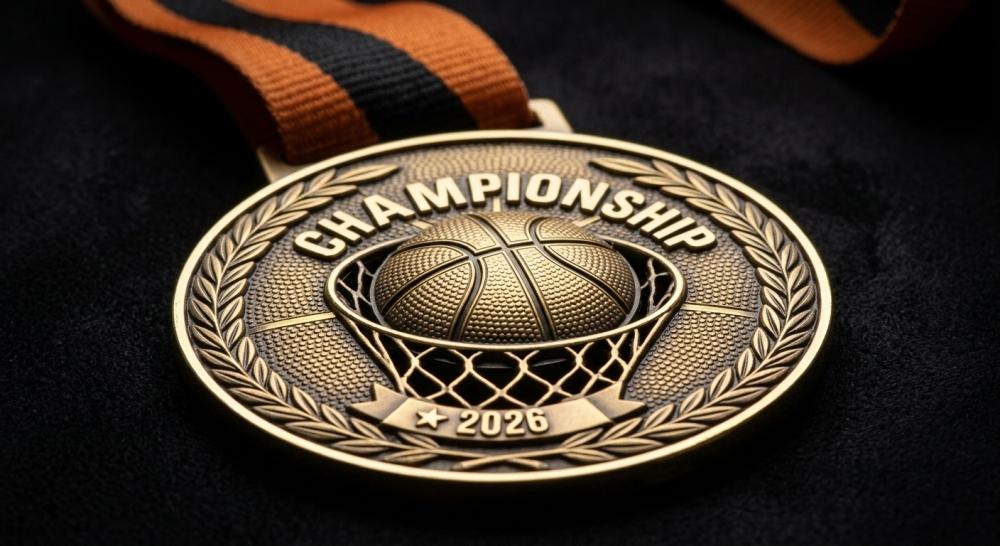
Here's a direct, side-by-side look at how 2D soft enamel and 3D die-cast construction compare across the factors that matter most when sourcing custom basketball tournament medals.
| Factor | 2D Soft Enamel | 3D Die-Cast |
|---|---|---|
| Design Complexity | Best for flat logos, clean vector graphics, simple text | Handles detailed sculptural elements, figures, and textures |
| Dimensional Depth | Flat surface with recessed color-filled sections | True raised/sculpted relief with real physical depth |
| Tactile Feel | Smooth, low-relief surface | Pronounced texture — pebbled basketball surface, net weave, rim edges |
| Price Range | Lower cost per unit | Higher cost per unit due to complex mold engineering |
| Best Suited Event Level | Youth leagues, participation medals, high-volume budget orders | Championship awards, MVP honors, premium tournament finals |
| Production Turnaround | Faster (simpler mold process) | Slightly longer (more detailed mold engineering) |
2D soft enamel remains one of the most widely used production methods for custom basketball tournament medals, and for good reason — it delivers strong visual results at a highly manageable cost for the right kind of design.
Soft enamel construction works by die-striking a design into a flat metal base, then filling the recessed sections with liquid enamel color, separated by raised metal lines. This process excels at reproducing crisp, clean vector artwork — sharp league logos, bold typography, and flat color blocks — with excellent color accuracy and clarity. For youth basketball leagues and budget-conscious tournaments where the priority is a clean, professional-looking logo rather than realistic sculptural detail, 2D soft enamel consistently delivers strong results without the added cost of complex 3D mold engineering.
Because soft enamel medals rely on a comparatively simpler die-striking process rather than the more intricate multi-depth mold engineering required for true 3D sculpting, both the initial mold/tooling fee and the per-unit production cost tend to run lower. This also typically translates into a faster manufacturing turnaround, since simpler molds require less engineering and adjustment time before mass production can begin. For league operators managing tight budgets across a large roster of participation medals, these cost and speed advantages often make 2D soft enamel the clear practical choice for the majority of a bulk order.
For medals meant to feel like a genuine trophy-caliber achievement, 3D die-cast construction offers a level of realism and physical presence that flat 2D designs simply can't replicate.
3D die-cast medals are formed using a mold engineered with genuine depth and multi-level relief, allowing for realistic sculptural detail that 2D enamel simply cannot achieve — the pebbled texture of an actual basketball's surface, a dynamic sculpted figure of a player mid-shot or mid-dunk, or an intricate cutout basketball rim and net design with real dimensional space. This level of detail requires a design and engineering team with genuine hands-on casting experience, since translating fine texture and figure detail from a digital rendering into a mold that casts cleanly at scale is a nontrivial technical challenge.
Beyond visual detail, 3D die-cast medals typically carry noticeably more physical weight and thickness than their 2D soft enamel counterparts, which contributes directly to the sense of prestige and permanence a championship winner expects from a top-tier award. This combination of true sculptural detail and substantial heft is exactly why 3D die-casting remains the standard choice for championship, runner-up, and individual honor medals in custom basketball tournament medals programs — award tiers where the recipient is meant to feel they've received something genuinely special, not a mass-produced trinket.
Whether you choose 2D soft enamel or 3D die-cast construction, the final plating finish plays a significant role in how the completed medal actually looks and feels.
Traditional metallic plating options remain the most common and versatile choice for basketball award medals. Bright, high-polish gold plating is the standard for championship and first-place awards, with corresponding silver and bronze finishes for second and third place. Antique bronze offers a slightly more understated, textured alternative that works well for participation or secondary award tiers, while black nickel plating has become an increasingly popular modern option for leagues wanting a sleek, contemporary look that stands apart from traditional gold/silver/bronze conventions.
For 3D die-cast medals specifically, dual-plating techniques — where a darker antique finish is applied to recessed background areas while the raised, high-relief details are polished to a brighter shine — create genuine visual depth by drawing the eye directly to the sculpted elements. This contrast finish is particularly effective for showcasing detailed textures like a pebbled basketball surface or a sculpted net, since the antique shading in the recessed areas naturally emphasizes the raised, polished high points, making the 3D detail read clearly even in photographs.
Yes, 3D die-cast medals generally carry a higher per-unit cost than 2D soft enamel, primarily due to more complex mold engineering and the additional production steps needed to achieve clean, detailed relief work at scale. That said, the cost gap narrows somewhat at higher order volumes, since the upfront mold/tooling fee gets amortized across more units either way. Many organizers manage this cost difference by reserving 3D die-cast construction for lower-volume championship and individual honor tiers, while using more cost-efficient 2D soft enamel for the much larger participation medal tier.
Yes. It's common and visually effective to combine both techniques within a single medal design — using a 3D die-cast base for structural depth and sculptural elements, then applying soft or hard enamel color fill to specific flat sections, such as a team logo or a background color block. This hybrid approach delivers the realism and premium feel of 3D construction while still incorporating the crisp, accurate color reproduction that enamel fill does best, giving organizers the visual benefits of both techniques in one medal.
Choosing between 2D soft enamel and 3D die-cast construction for your custom basketball tournament medals doesn't have to be a guessing game. Shenzhen Vistarts Craft Co., Ltd. is a self-owned factory established in 2011, with over 10,000 square meters of production space, 150+ employees, 50+ modern machines, and 5 dedicated production lines equipped to handle both manufacturing techniques in-house.
Our in-house design team of 20+ professionals has hands-on production expertise across both soft enamel and 3D die-cast processes, helping you decide exactly where to allocate budget — reserving premium 3D sculptural detail and dual-plating finishes for your championship and MVP tiers, while keeping high-volume participation medals cost-efficient with clean 2D soft enamel construction. With access to over 1,000 existing custom medal designs, ISO9001 certification, RoHS and CE compliance, a dedicated 10+ person QC team, and a full refund guarantee if bulk production ever deviates from your approved sample, we help you strike the right balance between visual impact and budget for every tier of your tournament's awards.
Weighing 2D vs. 3D for your next tournament? Share your award tier structure and budget with our team, and we'll recommend the manufacturing approach that gets you the best result for your money. Visit vistarts.com to request your free custom quote and design consultation today.

58 South Union Road, South Union Community, Shenzhen, Guangdong, China