View:14666Time:2026.08.23
When most organizers think about custom cycling medals for events, they focus almost entirely on the metal medallion itself — the plating, the 3D detail, the mechanical design. But the ribbon and hardware holding that medal around a rider's neck deserve just as much attention, especially in cycling. Cycling medals tend to run noticeably heavier and larger than typical running finisher medals, often incorporating thick zinc alloy castings, spinning mechanical elements, or functional add-ons like bottle openers. That added weight puts real, ongoing stress on ribbon width, stitching, and hardware attachment points — stress that a standard lightweight running-medal ribbon simply isn't built to handle. This guide covers exactly what to look for in ribbon sizing and durability, how to design a high-impact cycling lanyard that reinforces your route branding, and the alternative hardware and mounting options that turn a cycling medal into something riders actually use long after race day.
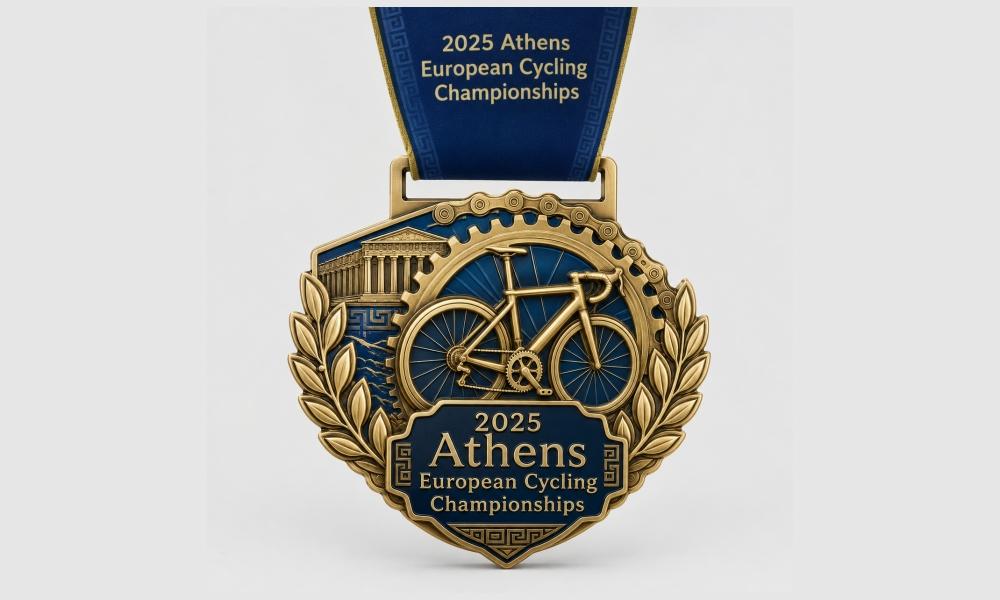
Before going into detail, here's a quick-reference summary of the ribbon and hardware specifications that matter most for heavy custom cycling medals for events.
| Component | Recommended Spec | Why It Matters |
|---|---|---|
| Ribbon Width | 1.5" to 2.0" | Distributes heavy medal weight comfortably across the neck |
| Stitching | Reinforced cross-stitch (V-sew) | Prevents tearing during podium celebrations and repeated use |
| Printing Method | Dye-sublimation, full color, double-sided | Reproduces route maps, elevation gradients, and sponsor logos crisply |
| Attachment Ring | Heavy-duty jump ring or reinforced ribbon loop | Ensures structural integrity for thick zinc alloy castings |
| Alternative Mount | Carabiner or keyring attachment | Converts the medal into a functional bike bag accessory |
The ribbon is the first structural component that has to physically account for a cycling medal's added weight and size — get it wrong, and even a beautifully designed medal becomes uncomfortable or, in the worst case, breaks.
Standard running event ribbons are frequently in the 1.0" to 1.25" range, which works fine for lighter finisher medals but becomes genuinely uncomfortable — even mildly painful with extended wear — under the weight of a heavy 3.5" to 4.0" cycling medal, particularly one incorporating a thick zinc alloy casting or added mechanical elements like a spinning gear center. For custom cycling medals for events at this scale, a wider 1.5" to 2.0" ribbon is effectively mandatory: the increased surface contact area spreads the load across more of the back of the neck, meaningfully improving comfort for riders who may be wearing the medal for hours at a post-race celebration or awards ceremony.
Where the ribbon loop closes and connects to the medal's attachment hardware is the single highest-stress point on the entire assembly — and it's exactly where budget ribbons tend to fail first. Reinforced cross-stitching, often called V-sew stitching, adds multiple overlapping stitch lines at this junction rather than a single straight pass, dramatically increasing tear resistance. This matters in cycling specifically because heavier medals put continuous tension on that stitch point, and podium celebrations often involve riders raising medals overhead, swinging them, or bumping into teammates — exactly the kind of repeated stress a single-line stitch isn't built to survive long-term.
A cycling medal's ribbon isn't just structural — it's valuable branding real estate that riders wear visibly for the entire post-race period, making thoughtful lanyard design a real opportunity rather than an afterthought.
Dye-sublimation printing allows for full-color, photo-quality graphics printed directly into the ribbon fabric rather than sitting on top of it, which means the design won't crack, peel, or fade the way lower-quality screen-printed ribbons can over time. For cycling events specifically, this opens up a genuinely popular design option: printing the race route's elevation profile as a continuous gradient chart running the length of the ribbon, giving riders a literal visual record of exactly what they climbed, worn proudly alongside the medal itself. This pairs especially well with Gran Fondo and road events built around a signature mountain pass or challenging climb.
Cycling events often carry sponsor relationships specifically tied to the cycling industry — component manufacturers, local bike shops, nutrition brands, and cycling apparel companies — and the ribbon is one of the most effective places to fulfill these sponsorship commitments without cluttering the medal face. A common, visually clean approach alternates your event's own logo/name with sponsor logos in a repeating pattern along the ribbon length, ensuring consistent brand visibility for both the event and its sponsors every time the ribbon is worn or displayed.
Beyond the ribbon itself, the hardware connecting the medal to its ribbon — and alternative mounting options beyond the traditional neck ribbon — play a significant role in both durability and long-term usability.
The small metal jump ring or loop connecting the medal to its ribbon has to bear the medal's full weight at a single, concentrated point — a spec that's easy to overlook but critical for heavier cycling medals. Thin, undersized jump rings designed for lightweight running medals can bend, deform, or fail entirely under the sustained weight of a thick zinc alloy cycling medal, particularly one with added mechanical components. Specifying a heavy-duty jump ring gauge (or, in some designs, an integrated reinforced ribbon loop cast directly into the medal itself) appropriately matched to your medal's actual weight is a small design decision that prevents a genuinely common failure point.
An increasingly popular option for custom cycling medals for events is offering an alternative attachment — a small carabiner clip or keyring loop — either instead of or in addition to the standard neck ribbon. This taps directly into cycling culture's practical, gear-focused mindset: a medal that can clip onto a saddle bag, hydration pack, or keychain is far more likely to see continued everyday use than one that only makes sense worn around the neck, extending your event's branding visibility well beyond race day itself.
For MTB, Enduro, and gravel events where ribbons are likely to encounter dust, mud, or moisture, a tightly woven polyester ribbon is generally the more practical choice over silk or satin blends — polyester holds up better to repeated handling, resists fraying, and is easier to wipe clean without damaging the printed design. Dye-sublimation printing (rather than surface screen-printing) also helps here, since the ink is embedded in the fabric rather than sitting on top of it, making it more resistant to abrasion from dirt and grit.
Yes. Dye-sublimation printing supports full-color, vector-quality graphics on both sides of the ribbon simultaneously, which is exactly why it's the preferred method for cycling event ribbons that need to display both event branding and multiple sponsor logos clearly. Double-sided printing means the design reads correctly regardless of which way the ribbon twists while being worn, an important practical detail for a design element riders will have on for an extended period post-race.
A great medal design deserves a ribbon and hardware system built to match its weight and purpose. Shenzhen Vistarts Craft Co., Ltd. is a self-owned factory established in 2011, with over 10,000 square meters of production space, 150+ employees, 50+ modern machines, and 5 dedicated production lines, giving us full in-house control over both medal casting and ribbon/hardware production for custom cycling medals for events.
Our in-house design team of 20+ professionals understands the structural demands of heavier cycling medal designs, specifying appropriate ribbon widths, reinforced V-sew stitching, and correctly sized jump rings or integrated loops based on your medal's actual weight — not a generic one-size template borrowed from lighter running medals. We offer full dye-sublimation printing for route maps, elevation gradients, and sponsor branding, along with alternative carabiner and keyring attachment options. Backed by ISO9001 certification, RoHS/CE-compliant materials, a dedicated 10+ person QC team, and a full refund guarantee if bulk production ever deviates from your approved sample, we make sure every component of your cycling medal — not just the medallion — is built to last.
Ready to finish your cycling medal design? Share your medal weight, route details, and sponsor requirements with our team, and we'll help you spec the ribbon and hardware to match. Visit vistarts.com to request your free custom quote today.

58 South Union Road, South Union Community, Shenzhen, Guangdong, China